10 Books to Read This Dussehra: Mythology, Dharma and the Triumph of Good
Celebrate Dussehra with 10 books inspired by the Ramayana, Indian mythology, dharma and the timeless struggle between good and evil.on Oct 20, 2026
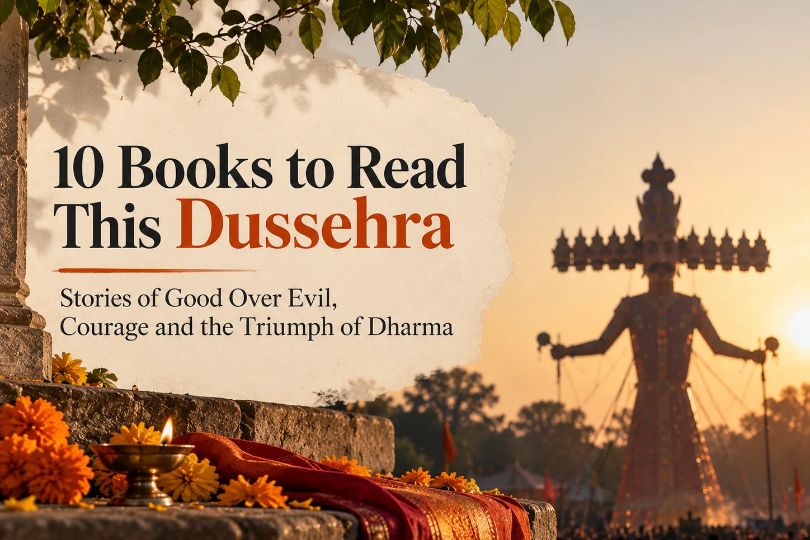
Dussehra, also known as Vijayadashami, is one of India’s most significant festivals, celebrating the victory of good over evil. The burning of Ravana’s effigy symbolises the destruction of arrogance, greed and injustice, while the festival reminds us of the enduring importance of truth, courage, duty and righteousness.
At the heart of Dussehra lies the Ramayana, an epic that has inspired generations of readers, writers, poets and storytellers. Its themes continue to find expression in contemporary literature, retellings of Indian mythology and books that examine the complexities of human nature.
For readers, the festival offers an opportunity to revisit these timeless narratives and discover books that explore the meaning of dharma, the consequences of our choices and the strength required to stand up for what is right.
This Dussehra, here are 10 books worth adding to your reading list.
1. The Ramayana by Valmiki
No reading list for Dussehra would be complete without the Ramayana, traditionally attributed to the sage Valmiki. The epic follows Lord Rama’s journey into exile, Sita’s abduction by Ravana, Hanuman’s devotion and the eventual battle in Lanka.
Beyond the familiar story of Rama’s victory, the epic explores duty, sacrifice, loyalty, leadership and the difficult choices that shape human lives. It remains a foundational text for understanding the cultural and spiritual significance of Dussehra.
Why read it this Dussehra? To revisit the story behind the festival and reflect on the enduring meaning of righteousness and responsibility.
2. Ramayana: A Retelling by Ramesh Menon
For readers looking for an accessible narrative of the epic, Ramesh Menon’s Ramayana: A Modern Retelling of the Great Indian Epic offers a contemporary prose rendition of the traditional story.
The book brings together the major characters, events and moral dilemmas of the Ramayana in a narrative form suited to readers who want to engage with the epic without approaching it as a verse translation.
Why read it this Dussehra? To experience a familiar epic through a retelling that makes its vast narrative more approachable for modern readers.
3. The Forest of Enchantments by Chitra Banerjee Divakaruni
What happens when a familiar epic is retold through the voice of a woman whose experiences have often been viewed through someone else’s perspective?
In The Forest of Enchantments, Chitra Banerjee Divakaruni reimagines the Ramayana through Sita’s perspective. The novel explores her childhood, marriage, exile, abduction and the emotional complexities of her relationship with Rama.
By centring Sita’s experiences, the narrative invites readers to reconsider questions of identity, sacrifice, love and the expectations placed upon women.
Why read it this Dussehra? To explore the Ramayana from a different perspective and reflect on the many voices within a story that has been told for centuries.
4. Asura: Tale of the Vanquished by Anand Neelakantan
What if the story of good versus evil looked different from the other side of the battlefield?
Anand Neelakantan’s Asura: Tale of the Vanquished reimagines the Ramayana through the perspectives of Ravana and Bhadra. The novel challenges conventional assumptions about heroes and villains, inviting readers to consider how power, social hierarchy, ambition and personal experience influence the way stories are remembered.
Rather than presenting the familiar narrative as a straightforward conflict, the book explores the complexities behind the characters and the society they inhabit.
Why read it this Dussehra? To question easy definitions of good and evil and consider how perspective shapes our understanding of morality.
5. Lanka’s Princess by Kavita Kane
Surpanakha is often remembered as a character whose encounter with Rama and Lakshmana sets important events of the Ramayana in motion. But what lies behind the familiar portrayal of Ravana’s sister?
In Lanka’s Princess, Kavita Kane revisits the Ramayana through Surpanakha’s life, exploring her ambitions, relationships, losses and the circumstances that shape her actions.
The novel shifts attention towards a character frequently relegated to the margins of the epic, demonstrating how retellings can uncover new dimensions within familiar narratives.
Why read it this Dussehra? To discover how revisiting a secondary character can transform our understanding of an epic and its central conflict.
6. Sita: An Illustrated Retelling of the Ramayana by Devdutt Pattanaik
Devdutt Pattanaik’s Sita: An Illustrated Retelling of the Ramayana offers another interpretation of the epic, placing Sita at the centre of the narrative.
Combining storytelling with illustrations and cultural interpretation, the book explores the Ramayana through Sita’s journey and examines the symbolism, traditions and perspectives associated with her story.
It also encourages readers to recognise that Indian epics exist in multiple versions across regions, communities and storytelling traditions.
Why read it this Dussehra? To explore the cultural richness of the Ramayana and discover how a change in narrative focus can reveal new meanings.
7. The Palace of Illusions by Chitra Banerjee Divakaruni
Although it belongs to the Mahabharata tradition rather than the Ramayana, The Palace of Illusions is an excellent companion read for Dussehra because it examines power, pride, justice, gender and the consequences of human choices.
The novel retells the Mahabharata through the perspective of Draupadi, bringing her inner life, ambitions and experiences to the forefront. It explores the events leading towards the great war and the complicated relationships that shape the epic.
Its characters resist simple categorisation, making the story particularly relevant to readers interested in the moral ambiguities of Indian mythology.
Why read it this Dussehra? To reflect on how pride, injustice and the misuse of power can set devastating events in motion.
8. The Difficulty of Being Good: On the Subtle Art of Dharma by Gurcharan Das
The victory of Rama over Ravana is often understood as a triumph of righteousness. But what does it actually mean to do the right thing when every choice has consequences?
In The Difficulty of Being Good, Gurcharan Das examines the moral questions raised by the Mahabharata and connects its dilemmas with contemporary life. The book considers questions of duty, justice, ambition, revenge and personal responsibility.
Its central concerns resonate with the spirit of Dussehra, reminding readers that the struggle between right and wrong is not confined to legendary battles.
Why read it this Dussehra? To examine dharma as a living ethical question rather than simply a battle between heroes and villains.
9. Indian Mythology: Tales, Symbols, and Rituals from the Heart of the Subcontinent by Devdutt Pattanaik
For readers who want to explore the larger world of Indian mythology, Devdutt Pattanaik’s Indian Mythology: Tales, Symbols, and Rituals from the Heart of the Subcontinent provides an introduction to the stories, symbolism and traditions that shape the subcontinent’s mythological imagination.
The book helps readers understand the cultural contexts in which myths develop and the different meanings attached to divine figures, rituals and narratives.
Read alongside the Ramayana, it can broaden the understanding of how stories about good, evil, duty and transformation have been interpreted across Indian traditions.
Why read it this Dussehra? To explore the wider mythological landscape that has influenced Indian literature, festivals and storytelling for generations.
10. Ram: Scion of Ikshvaku by Amish Tripathi
The first book in Amish Tripathi’s Ram Chandra series, Ram: Scion of Ikshvaku, reimagines the life of Rama in a fictionalised narrative that combines mythology, political conflict and questions of leadership.
The novel explores Rama’s upbringing, his relationship with duty and the challenges surrounding the kingdom of Ayodhya. It presents a version of the familiar story through the conventions of contemporary popular fiction.
For readers who enjoy mythology-inspired novels, the book offers a modern entry point into the world of the Ramayana.
Why read it this Dussehra? To discover how a traditional epic can inspire new fictional interpretations for contemporary audiences.
Beyond the Burning of Ravana: What Dussehra Teaches Us Through Books
Dussehra is more than a festival marking the defeat of Ravana. It is an invitation to reflect on the choices that define us, the values we uphold and the consequences of our actions.
The books on this list approach that message from different directions. Some return to the traditional narrative of Rama’s journey, while others centre characters whose stories are often overlooked. Some question established ideas of heroism, and others examine the difficult relationship between morality, duty and justice.
Together, they demonstrate the continuing relevance of Indian epics and the power of literature to make familiar stories feel new again.
As readers celebrate Dussehra this year, picking up a book inspired by the festival can be a meaningful way to connect with its deeper themes. After all, the triumph of good over evil is not merely a story to remember once a year; it is a question we can continue to explore through the books we read and the choices we make.
This Dussehra, let the stories you read inspire reflection, courage and a renewed commitment to what is right.
Post a comment
0 comments

Trending Posts







Recent Post


Related Post

.jpg)
.jpg)
.jpg)

 (1).jpg)
.jpg)

© 2026 - Frontlist - News and Updates of Publishing Industry, Book Reviews, Education News, Author Interviews, and Videos.. All Rights Reserved.
Sorry! No comment found for this post.